
XPages Performance: Why Computed Values Run Many Times per Submit
You drop a print(...) into a computed value, or a control’s rendered formula, click a button once — and that line prints five, six times in the console. You clicked once; why did it run so many times?
It isn’t a bug. XPages runs a whole JSF lifecycle (six phases) on every submit, and a value binding written with #{} is re-evaluated every time it’s read; across several phases, that adds up to several runs per submit. Harmless most of the time — but when that computed code holds an @DbLookup, a loop, or a pile of logic, it becomes a real performance killer.
The good news is there are knobs for this — and they aren’t magic, just understanding when something should be computed once versus re-computed every time. This piece covers the three with the most impact: #{} vs ${}, and rendered vs loaded. (For the lifecycle and partial refresh/execution background, see partial refresh vs partial execution.)
TL;DR
- One submit = one whole JSF lifecycle, and a
#{...}(compute dynamically) value binding is re-evaluated each time it’s read — several times across the phases. ${...}(compute on page load) runs once at page load, bakes the result in as a static value, and doesn’t re-compute after that (official: pound#{}= compute dynamically, dollar${}= compute on page load). If a value won’t change within one request, use${}.- Caveat:
${}can’t reference objects built later in the lifecycle — arepeatcontrol’s row variable, per-request data source values — those don’t exist yet at load. Those need#{}. rendered(false = in the component tree, just not shown) is still evaluated across the lifecycle phases;loaded(false = never built into the tree) skips all of it. If visibility is fixed within a request,loadedis cheaper thanrendered.- Don’t mix
${}and#{}in one expression — it forces the#{}to evaluate at load too, and the behavior won’t be what you expect.
How many times your computed runs per submit: the JSF lifecycle
XPages is built on JSF, and a submit runs six phases in order: Restore View → Apply Request Values → Process Validations → Update Model Values → Invoke Application → Render Response. The catch: a property (a control’s rendered, or a computed field’s value) isn’t read just once at render time — it’s read several times along the way; each time JSF needs that value, it runs your binding again.
So the same #{javascript:...} can be evaluated five or six times for a single button click. If it’s a string concatenation, no harm; if it’s an @DbLookup, a @DbColumn, opening a view, or a loop, that’s “one click, the same heavy work done several times.” The root of a performance problem is often right here.
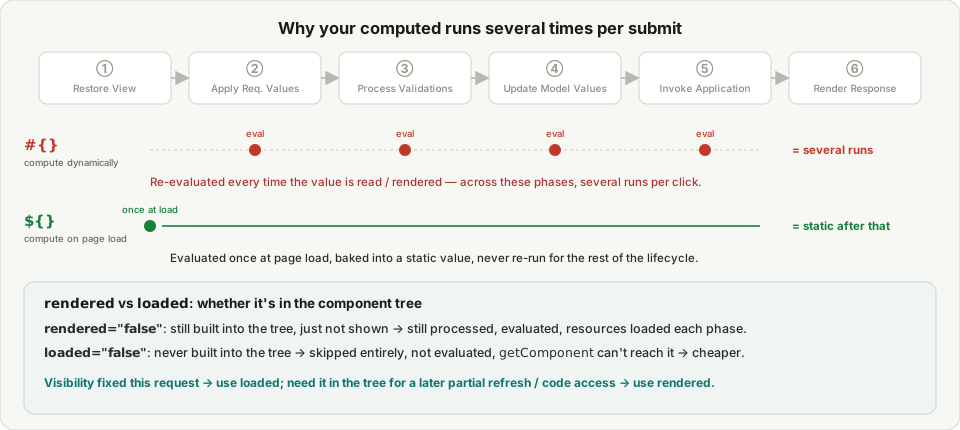
#{} vs ${}: re-computed every time vs computed once at load
These two symbols are the most-confused — and highest-leverage — spot in XPages (official Value binding):
#{...}= compute dynamically (pound): a value binding, re-computed every time that element is read / rendered. It’s what the Designer property panel’s “Compute Value” gives you, and it’s the default.${...}= compute on page load (dollar): a load-time binding, evaluated once when the page first loads, baked into the component as a static value, and not re-computed for the rest of the lifecycle (Intec’s write-up:${}runs at load,#{}is deferred).
That’s the lever: if a computed result won’t change within this request, use ${} so it runs once instead of letting #{} re-run every phase. You don’t need to sweat it early on, but at scale — or when the computed code does real work — converting the should-be-static ones to ${} is tangible.
Two limits to remember:
${}can’t reference “things not built yet.” It computes at load, so if your expression references arepeatcontrol’s row variable, or a data source value that only loads per request, those objects don’t exist yet at load and${}gets nothing (or the wrong thing). That dynamic data needs#{}.${}and#{}can’t be mixed in one expression. The whole value property is handed to the underlying layer as one string; mixing forces the#{}part to evaluate at load too, and the behavior stops matching what you intended.
rendered vs loaded: whether it’s in the component tree at all
The second knob is about whether a control even exists. Both rendered and loaded can make a control “not appear,” but the cost is wildly different (Loaded vs Rendered):
rendered="false": the control is still built into the component tree, just not shown. It’s still processed through the lifecycle phases, its bindings still evaluate, and even the dojo/resources it needs are still detected and injected into the HTML header.loaded="false": the control is never built into the tree at all. XPages skips it outright — no processing, no evaluation, no resources, and your code can’t get at it (getComponentreturns nothing).
So: if whether a block of UI appears is fixed within a request (by role, by document mode), loaded is much cheaper than rendered, because it takes the whole control — and the computation under it — out of the lifecycle. Use rendered instead when you need the control “still in the tree, just hidden for now, to be shown by a later partial refresh” or “reachable from code.”
Related: when to read a value, and converters
Since we’re on the lifecycle, two related points worth keeping:
- Early phases only have the
submittedValue(a string); the typedgetValue()isn’t there until after phase 4, Update Model Values. So reading the same field in different phases gives you different things — the same lifecycle thatdocument1.getDocument(true)hinges on for “when the value reaches the data source.” - Disabling validation doesn’t skip the converter: even with validation off, type conversion still runs. Don’t assume “validation off” means “everything is saved.”
In practice: when to use which
Boiled down to a few rules you can keep:
- A value that won’t change within this request →
${}(computed once at load). One that does change (per-row, per-request dynamic data) →#{}, and keep what’s inside it cheap. - Visibility that’s fixed within this request →
loaded(takes the whole block out of the lifecycle). Need it in the tree, for a later partial refresh or programmatic access →rendered. - Not sure how many times it runs → drop a counter or a
printin, click once, and watch how many times it fires; let the number decide whether to switch to${}/loaded.
Wrap-up
Your computed value running several times per submit isn’t a bug — it’s a #{} (compute dynamically) value binding re-evaluating every time it’s read across the whole JSF lifecycle. Switch the values that don’t change within a request to ${} (compute on page load, once), and switch controls whose visibility is fixed from rendered to loaded (never built into the tree), and you take the repeated work out of the lifecycle. Remember ${}’s two limits (can’t reference objects built later, can’t mix with #{}), add a counter to measure, and the places worth saving become visible.
Sources
- Value (control and data binding) (#{} pound = compute dynamically / ${} dollar = compute on page load) — HCL Domino Designer (official)
- XPages Bindings: When # Runs at Page Load (${} evaluated once at load, #{} deferred; the two can't be mixed) — Intec (Paul Withers)
- XPages Tip: Loaded Vs Rendered (loaded isn't built into the tree; rendered is built but still processed each phase) — Matt White
- Understanding Partial Execution: Part Three – JSF Lifecycle (lifecycle phases and computed/rendered recalculation) — Intec (Paul Withers)