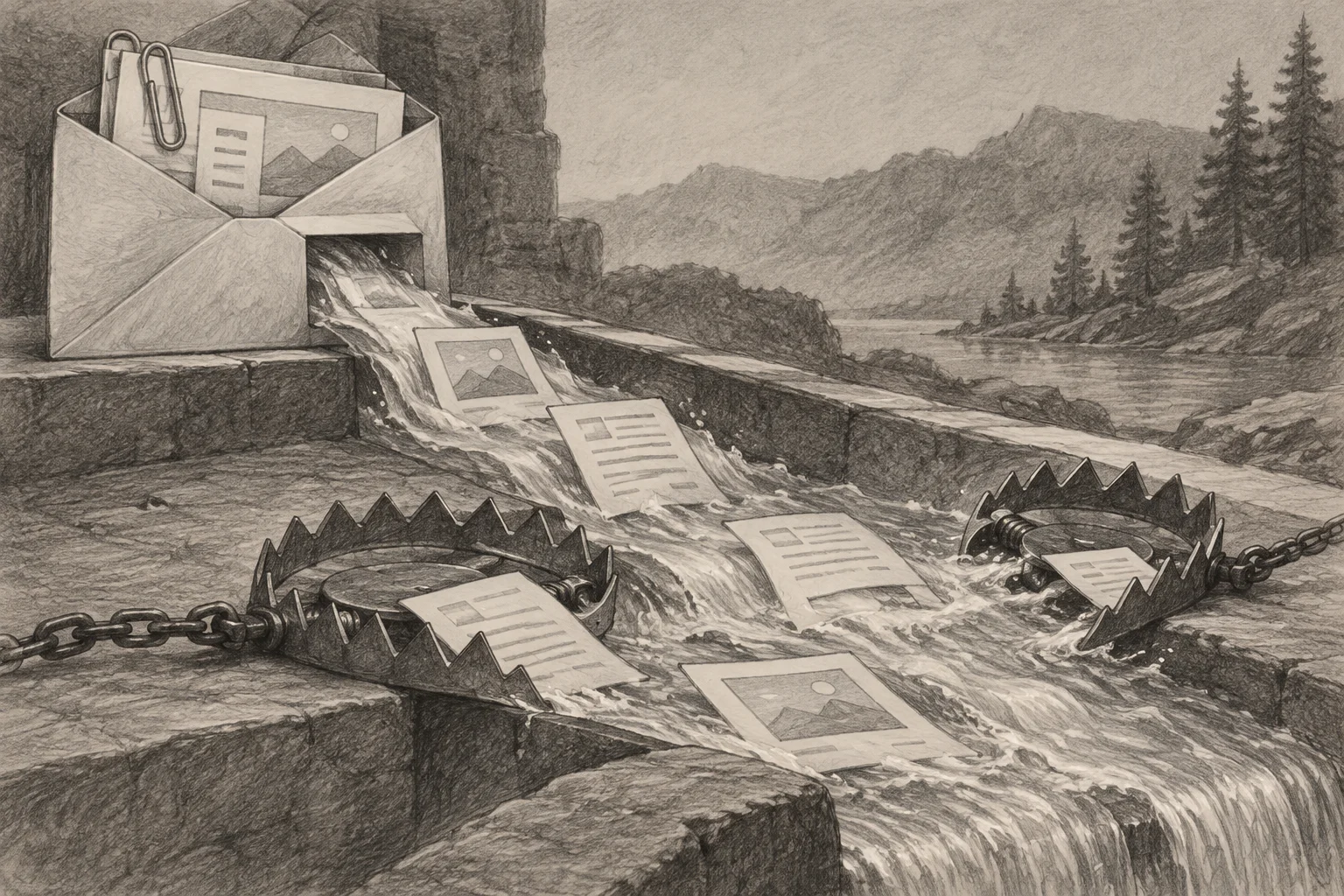
Attachments in Java: Stream with getInputStream, and Two Traps That Bite
In Java you want an attachment’s content — to stream it to a browser download, take a SHA-256, or push it to S3. The reflex: extractFile it to a temp file, then read that file back.
You don’t have to make that round trip. EmbeddedObject in Java has getInputStream — it reads the attachment’s content straight as an InputStream, with no temp file landing on disk. For “read it and hand it straight on” cases, that’s a lot cleaner.
This covers the streaming approach, plus two traps the docs state plainly but people still walk into.
Three kinds of EmbeddedObject — know which one you have
By the official definition, an EmbeddedObject represents one of three things: an embedded object (an OLE object), an object link, or a file attachment. getType tells you which.
One platform reality many people don’t know, stated right in the docs’ Note: embedded objects and object links are not supported on UNIX and Macintosh — only file attachments are. So on your Linux / AIX Domino server, the EmbeddedObject you meet is almost always a file attachment; embedded OLE objects simply don’t exist there. That actually simplifies things: server-side Java is usually just dealing with attachments.
Reading content: getInputStream doesn’t land, extractFile does
Two paths; picking the right one saves a lot:
getInputStream(orgetReader) — no landing. Read the attachment’s content as a stream and pipe it straight into your output (an HTTP response, a hasher, an upload). No temp file, nothing to clean up.
EmbeddedObject eo = rt.getEmbeddedObject("report.pdf");try (InputStream in = eo.getInputStream()) { in.transferTo(response.getOutputStream()); // streamed, nothing on disk}extractFile(path)— lands on disk. The docs: “Writes a file attachment to storage.” It writes the attachment to thepathyou give. Note that path is server-side — the back-end Java (agent or server code) runs on the Domino host and writes the host’s filesystem, not the user’s machine. Reach for it only when you genuinely need a file on disk (to hand to an external process, say).
And here’s trap one: extractFile only works on a file attachment; call it on an embedded object or an object link and the docs say plainly it throws an exception. So getType first and confirm it’s an attachment — don’t assume every EmbeddedObject can be extracted.
Trap two: Document.getEmbeddedObjects doesn’t return attachments
To get a document’s attachments you’d reach for doc.getEmbeddedObjects(), right? No. The docs are explicit: Document’s getEmbeddedObjects does not return file attachments (nor objects created in Notes R3). It returns embedded objects and links — and quietly leaves out the attachments you most often want.
Attachments come off the RichTextItem:
RichTextItem rt = (RichTextItem) doc.getFirstItem("Body"); // cast first (see the RichTextItem piece)Vector<?> objs = rt.getEmbeddedObjects(); // this one includes attachmentsOr, if you know the name, rt.getEmbeddedObject("report.pdf") directly. RichTextItem’s getEmbeddedObjects / embedObject is the front door for attachments; the cast of Body to RichTextItem, and the MIME caveat, are in the Java rich text piece.
What about recycle?
EmbeddedObject, the RichTextItem it belongs to, and the collections in your loop are all back-end handles — recycle() them when done in Java, and don’t free a parent too early. The full discipline is in the Java recycle blow-up piece; not repeated here.
What about LotusScript and SSJS?
The same EmbeddedObject, in each language:
- LotusScript:
NotesEmbeddedObject, withExtractFileto write an attachment to disk; nogetInputStream-style streaming read, and no recycle. The full catalogue is in the NotesEmbeddedObject piece. - SSJS / XPages:
NotesEmbeddedObject, with the sameextractFile/getType; the XPages request manages the lifecycle. - The Java-specific part is this piece:
getInputStreamlets you read an attachment without landing it, and strong typing makes the two traps —extractFile’s exception andDocument.getEmbeddedObjectsskipping attachments — bite sooner and surface faster. The broader attachment strategy is in attachments three ways.
Sources
- EmbeddedObject class (Java) (three types; getInputStream / getType; UNIX/Mac limitation) — HCL Domino 14.5 Designer Help (official)
- extractFile (EmbeddedObject - Java) (writes a file attachment; throws on non-attachments) — HCL Domino 14.5 Designer Help (official)
- RichTextItem class (Java) (embedObject / getEmbeddedObjects, the attachment entry point) — HCL Domino 14.5 Designer Help (official)